
Corporate Venture Capital: How to Keep Investments Innovative and Aligned
Last month, we explored the why behind corporate investment in early-stage supply chain startups. Companies ready to invest gain early access to innovation, a viable M&A pipeline, complementary R&D, and competitive intelligence.
Now let’s tackle the how: how to structure your corporate portfolio in a disciplined, strategic way that aligns with your business goals to deliver both strategic and financial returns.
We’ll use my personal investment thesis as a practical framework for your corporate venture playbook:
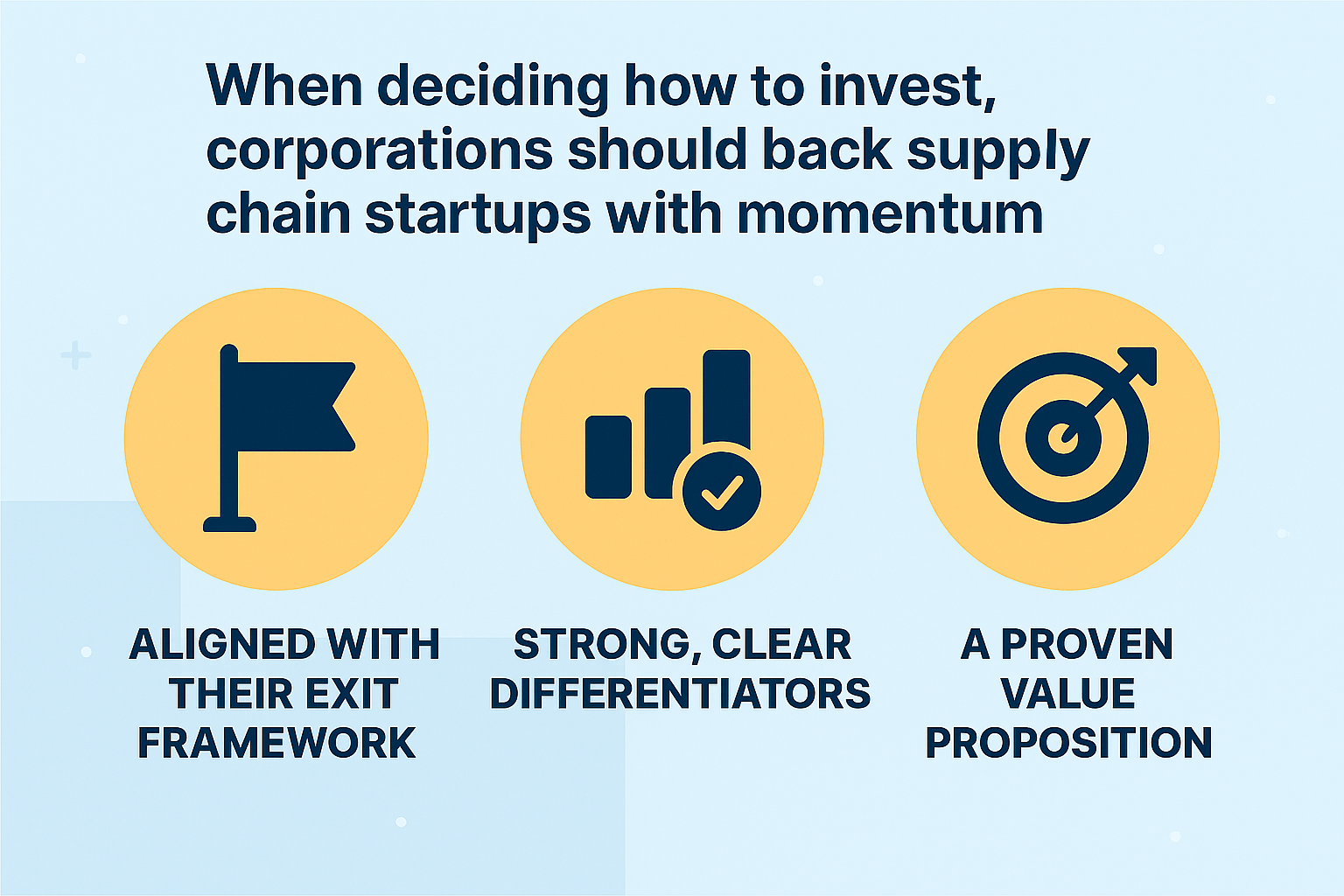
“Targeting Exit-Focused Investments anchored on Differentiation, where Talent accelerates a Value Proposition with positive Momentum.”
Let’s take a closer look at its key components..
1. Exit: Designing for Outcomes
When deciding where to invest, begin with the end in mind. Corporations often overlook exit dynamics in favor of overall strategic value, but exits matter. They can generate returns that sustain venture programs and create learning cycles.
Possible Outcomes: Acquisition by the corporation, third-party M&A, or IPO
Risks: Market adoption, regulatory shifts, founder turnover
Mitigation: Diversifying across multiple bets, keeping close alignment between business units and venture teams and appointing Board or observer seats to keep everyone informed
A clear exit framework keeps corporate venture programs accountable to their strategic and financial stakeholders.
2. Stay Focused: Supply Chain Tech Innovation
Focus is critical to investment success. To avoid spreading themselves thin, corporations with complex supply chains can define a thesis around key themes transforming and reshaping the landscape, including:
Visibility and Global Trade: Platforms enabling end-to-end transparency and regulatory compliance.
Resiliency and Productivity: AI-driven demand planning, process solutions, and smart manufacturing.
Automation and Digitization: Robotics, digital twins, and process automation across supply chain planning, sourcing, manufacturing, and delivery.
Making focused investments in these areas maintains coherence between your startup portfolio and your growth strategy.
3. Investment Stages, Terms, and Assumptions
When investing in supply chain startups, decide up front: which stages are in scope?
Seed/Series A: Maximum innovation exposure, which means higher risk, but strong learning value.
Series B+: Commercial traction, which means reduced risk, but higher entry valuations.
Terms should be structured to secure information rights, co-investment rights, and strategic collaboration options. A portfolio approach balancing early exploratory bets with later-stage de-risked plays—ensures both access to innovation and efficient capital growth.
4. Differentiation: What Makes the Startup Stand Out
Corporate venture teams can evaluate whether a supply chain startup offers true differentiation:
Is their business model scalable and defensible?
Is the problem they’re solving mission-critical to your supply chain, or just a “nice-to-have”?
Startups solving core pain points (e.g., regulatory compliance, freight optimization, labor shortages) often become indispensable, driving higher returns for individual, institutional, and corporate investors.
5. Talent: The Decisive Factor
Talent is the multiplier of innovation. Corporate leadership should assess each supply chain startup’s talent in a few key areas:
Founders: Do their founders demonstrate experience, energy, and resilience?
Teams: Is there functional supply chain expertise in their data science and engineering teams?
Investors: Who else is at the table: strong lead investors, complementary co-investors, or a mix of both?
The right combination of founders, teams, and investors accelerates execution and increases the likelihood of strategic relevance.
6. Value Proposition: Beyond the Pitch Deck
A supply chain startup’s value proposition must be measured against rigorous standards:
Total Addressable Market: Is it large enough to matter?
Go-to-Market Strategy: Are there distribution advantages or customer acquisition levers?
Growth Potential & Competitiveness: What does their Strengths, Weaknesses, Opportunities, and Threats (SWOT) analysis show, especially regarding incumbents?
Product-Market fit: Confirm the product or service will be used; the best ideas fail when there is no demand for them.
Technology Stack: Is it scalable, secure, and interoperable with corporate systems?
Such analysis keeps even visionary investments grounded in operational feasibility.
7. Momentum: Evidence of Progress
Momentum is the best predictor of future performance. Prioritize startups that demonstrate:
Revenue Growth: Early customer wins and recurring revenue streams
Customer Traction: Referenceable logos, pilot-to-scale transitions
User Adoption: Active engagement and sticky product usage.
Track momentum and progress over time to separate hype from substance.
Let’s Build a Corporate Venture Model That Works
By combining these strategies, your corporation can move beyond purely opportunistic investing to build a disciplined, strategic venture program powered by:
Scouting with Intent: Partnering with specialized funds and accelerators helps filter relevant deal flow
Governance and Alignment: Maintaining Board visibility and business units’ buy-in keeps innovation moving
Dual Objectives: Balancing financial returns with strategic learnings moves everyone forward
Supply chain technology is evolving at an unprecedented speed, but don’t let that scare you into reactivity. Corporations that approach venture investing with discipline— anchored in exit-focused, differentiated opportunities where talent drives momentum—see strong financial returns and position themselves as innovative industry leaders.
If you’re ready to design or refine a corporate venture program tailored to your supply chain priorities, let’s have a conversation. We can align your strategic needs with an investment approach that creates enduring value.
