
Blog 1/3 THE ILLUSION OF SCALABLE TECH: Why Supply Chain is the Real Constraint
THE MISPRICED LAYER: Why Supply Chain Will Define the Next Generation of Tech Winners
THE ILLUSION OF SCALABLE TECH: Why Supply Chain is the Real Constraint
For years, technology investing has been built on a powerful assumption:
The best businesses scale effortlessly.
More users. More revenue. Marginal costs trend toward zero.
That model worked—when value creation was largely digital.
It breaks down when growth meets the physical world.
Because today, the constraint is no longer demand. It is the ability to fulfill that demand—consistently, economically, and at speed.
And that capability sits squarely in the supply chain.
The Shift
Most investment frameworks still prioritize three questions:
· Is the product differentiated?
· Can it acquire customers efficiently?
· Will margins expand with scale?
The third question increasingly depends on something under-modeled:
Execution across the PLAN-to-CASH cycle.
Growth now requires synchronization across:
· suppliers and production
· inventory and working capital
· logistics and delivery performance
This is not operational detail. It is the mechanism through which revenue becomes realized value.
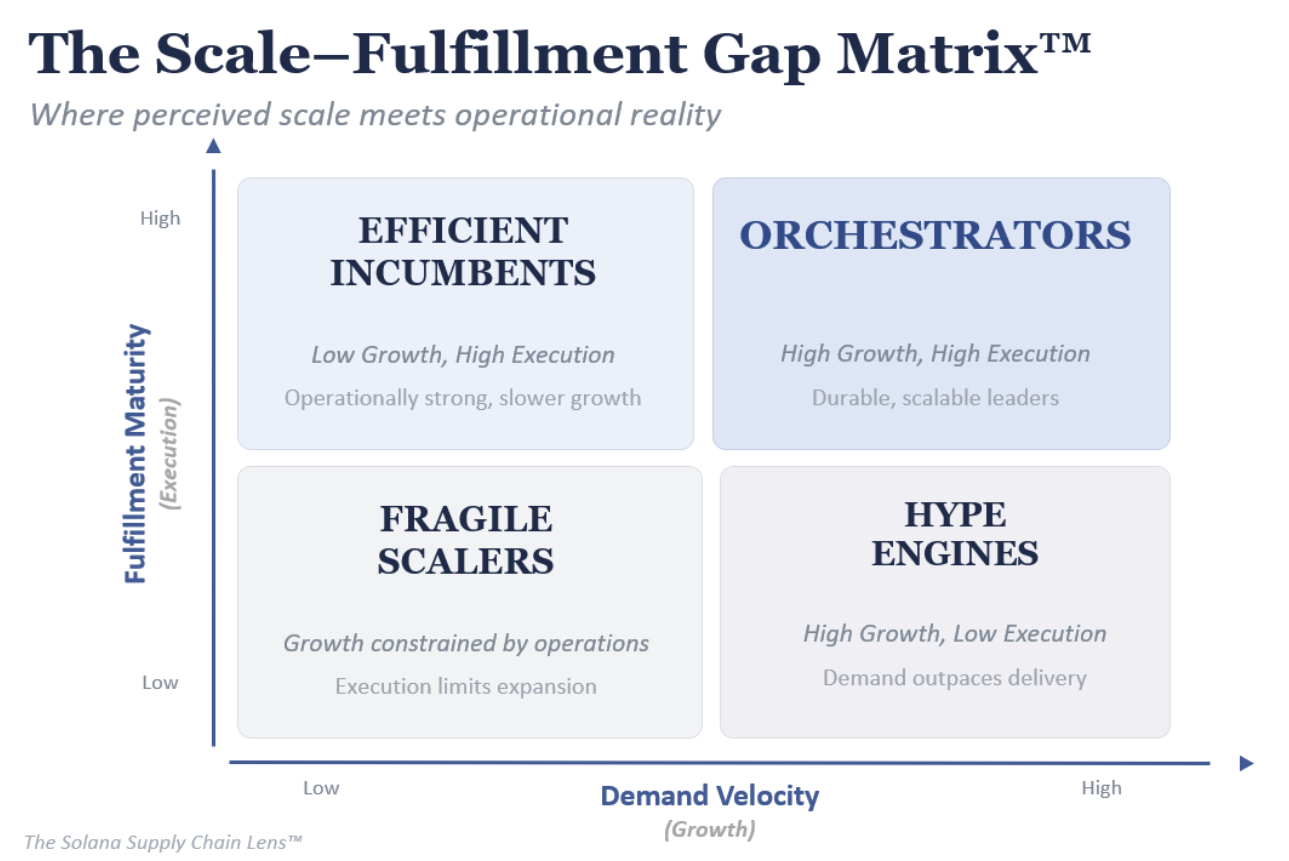
The Scale–Fulfillment Gap™
The disconnect shows up in a consistent pattern:
What companies can sell vs. What they can actually deliver—profitably
Call this The Scale–Fulfillment Gap Matrix™.
· Perceived scalability is what shows up in models
· Actual scalability is what shows up in operations
The distance between the two determines outcomes.
Where the Gap Shows Up
Consider Amazon.
Amazon’s advantage was not its demand generation alone. It was the deliberate build-out of a fulfillment and logistics system that improved:
· delivery speed
· cost-to-serve
· inventory positioning
Over time, that system became a structural advantage. Growth translated into consistency—and consistency into trust.
Now look at Peloton.
Demand accelerated rapidly. But supply chain decisions lagged:
· capacity expanded into peak demand
· demand normalized faster than expected
· inventory and logistics costs surged
The result wasn’t just operational friction. It was a breakdown between growth and value creation.
A different response can be seen in Tesla.
During periods of supply disruption, Tesla adjusted faster than many peers—supported by:
· tighter control over key inputs
· more direct supplier coordination
· faster production decision cycles
Not immune to disruption—but more adaptive to it.
Implications for Investors
The pattern is consistent:
Growth is easy to model. Fulfillment is harder to see—and more decisive.
Yet most investment processes still emphasize:
· market size
· growth rates
· product differentiation
And spend less time on:
· lead time variability
· supply network visibility
· cost-to-serve behavior at scale
· speed of operational response
These are not secondary metrics. They define revenue quality, margin durability, and downside risk.
A More Complete Lens
If supply chain is the constraint, it should be part of underwriting.
A few questions worth elevating:
· How quickly can supply adjust to demand shifts?
· Where are the dependencies across suppliers and regions?
· How does fulfillment cost evolve with growth?
· How resilient is the network under stress?
The answers won’t always be clean. But they are increasingly predictive.
Markets’ price growth efficiently.
They are less precise at pricing the ability to deliver that growth under real-world conditions.
That gap creates both risk—and opportunity.
Because the next generation of category leaders won’t just scale demand.
They will align demand, supply, and delivery into a single, coordinated system.
And that is where operational discipline becomes investment advantage.
