
The Rulebook Being Rewritten: What the USMCA Review Actually Tests
The Rulebook Being Rewritten: What the USMCA Review Actually Tests
Most companies have a tariff compliance checklist. Very few have a network that survives the review that produced it.
On July 1, 2026, the United States, Mexico, and Canada opened the first mandatory joint review built into any U.S. free trade agreement — a formal reassessment of a pact that underwrites roughly $1.8 trillion in annual North American trade. That is not a procedural footnote. It is the treaty equivalent of an open architecture review, conducted in public, with the outcome genuinely undecided.
For thirty years, I built and ran supply networks across Henkel, Bridgestone, Coty, Colgate-Palmolive, and DHL on an assumption I never had to say out loud: that the trade framework underneath the network was fixed infrastructure. Something you designed around, like a highway system — not something up for renewal. That assumption was always a convenience, not a fact. What has happened since July makes the fiction impossible to sustain.
Four Regimes, and Counting
Consider what's happened before the “real” negotiation has even concluded. In February 2026, the Supreme Court ruled 6–3 that the president lacked legal authority under emergency powers to impose the broad tariffs applied to Mexican and Canadian goods — eliminating that legal basis overnight. In its place came a temporary 10% global surcharge under a different statute. Two months later, the tariff structure on steel, aluminum, and copper was restructured again, expanding duty exposure on derivative products.
Then, two weeks ago, the fourth shift landed — and it's the one still dominating headlines as I write this. Talks between Washington and Ottawa collapsed on August 21. Within hours, the U.S. imposed 50% tariffs on roughly $20 billion of Canadian goods. Prime Minister Mark Carney called it a miscalculation, said Canada had been “attacked,” and announced retaliatory tariffs matching the U.S. measures dollar for dollar — targeting steel, dairy, and electronics — set to take effect September 8. Two G7 economies with a multi-decade history of stable trade relations are now in open tariff conflict, in the same month the treaty meant to prevent exactly this is under formal review.
Four distinct legal and political regimes inside eight months. That is the environment the USMCA review is actually being negotiated in — not the calmer backdrop most 2026 planning assumed.
Compliance Caught Up. Strategy Hasn't.
To their credit, exporters moved fast on the pieces they could control. USMCA utilization among Mexican exporters nearly doubled in a year — from under 45% in early 2025 to roughly 85% by January 2026 — as companies scrambled to qualify for duty-free treatment while it still existed in its current form. That is a real, measurable response, and Canada's current standoff is a preview of what happens to companies without that cushion: when a bilateral relationship deteriorates this fast, paperwork discipline buys you nothing if your sourcing base has no alternative to lean on.
But compliance and strategy are not the same discipline, and conflating them is where most organizations are exposed right now. Filing correctly under a regime that could look different in six months tells you your paperwork is current. It tells you nothing about whether your network can move if the regime does change.
This is the Scale–Fulfillment Gap™ again, at the macro level. The model says the network is USMCA-optimized. The operating reality is a set of qualified suppliers, rules-of-origin thresholds, and sourcing ratios calibrated to one specific version of the treaty — a version that is, by design, the subject of active, and now visibly contentious, negotiation this year.
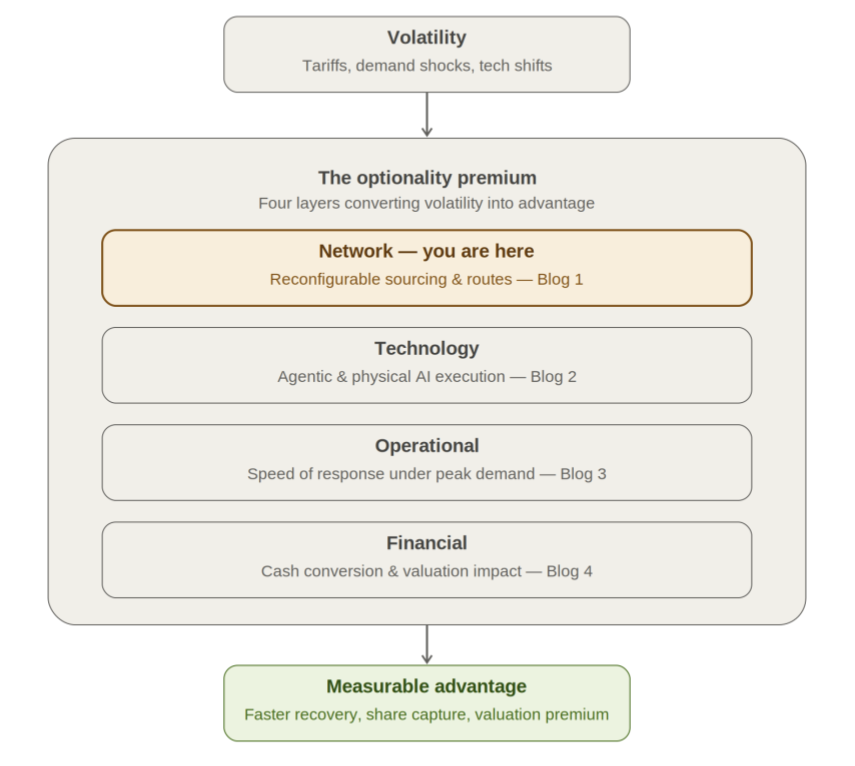
The Optionality Premium™
I want to name something explicitly here, because I think it is the single most underpriced asset in supply chain right now: the Optionality Premium™ — the measurable value of a network that can absorb a change in the rules without a redesign cycle.
I'd resist the temptation to treat a full, clean sixteen-year renewal as the baseline case. It was always the friendliest outcome, not the most probable one, and the last two weeks make it harder to argue it's where this settles. The more likely resting state, at least for now, looks like a provisional patchwork — bilateral flare-ups layered on top of a treaty that stays technically alive through rolling annual reviews, with no fixed date when the uncertainty actually resolves. That is not a cliff edge. It is arguably worse: an extended period in which the ground can move again, country by country, with little warning.
Capital is already pricing that uncertainty — cautiously. Mexico's FDI actually climbed to $41 billion in 2025, pushing it back into the global top ten and reversing its 2024 slide, driven largely by nearshoring-related manufacturing investment (UNCTAD, World Investment Report 2026). But UNCTAD's own analysis adds a qualifier worth sitting with: the same report notes a pronounced drop in green-energy project announcements and flags that some investments are being delayed as companies wait for trade and industrial policy conditions to stabilize. Capital is showing up. It just isn't fully committing yet — it is waiting to see whether any version of the rules holds long enough to underwrite a decade-long facility investment.
What Reconfigurable Actually Means
Optionality is not a hedge you buy once. It is a design property: qualified alternate suppliers that can absorb volume on short notice, rules-of-origin thresholds you actively manage rather than passively meet, contract terms that don't assume today's tariff rate — on either side of either border — is permanent, and a sourcing footprint across Mexico, Canada, and the U.S. that can shift weight without a multi-year requalification cycle.
Notice which sectors Canada's retaliatory list targets: steel, dairy, electronics. If your network has single-country dependency in any of those categories, right now, this week, is when that dependency gets tested. Companies with genuine optionality don't need to predict which of the three countries' relationships deteriorates next, or how the review ultimately resolves. They need the network to be indifferent to which one happens.
The Practical Question
If your network strategy depends on this review — or on U.S.-Canada relations, specifically — concluding a particular way, you don't have a trade strategy. You have a bet.
The Optionality Premium is what you're paid for not needing to win that bet.
Part 1 of a 4-part series on why optionality is becoming supply chain's most underpriced asset.
#SupplyChain #GlobalTrade #Nearshoring #Investing #OperationalAlpha #Manufacturing #VentureCapital #PrivateEquityThe Rulebook Being Rewritten: What the USMCA Review Actually Tests
Most companies have a tariff compliance checklist. Very few have a network that survives the review that produced it.
