
Agility Is a Muscle, Not a Motto: What Peak Season 2026 Is Actually Testing
Agility Is a Muscle, Not a Motto: What Peak Season 2026 Is Actually Testing
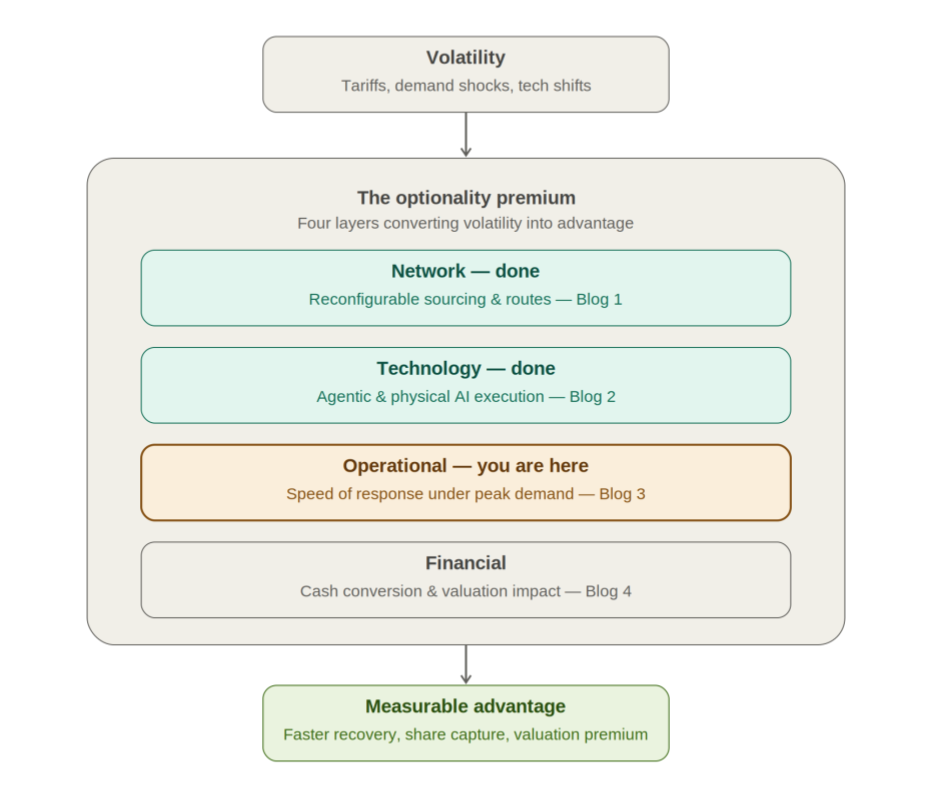
Resiliency is what keeps the network standing. Agility is how fast it moves once it's still standing. Most companies have built one and called it the other.
By the time this post is published, peak season is no longer a forecast — it's underway. And the read on 2026 is unambiguous: 52% of logistics and transportation stakeholders surveyed expect this peak to be more active than last year, nearly double the share who said the same twelve months ago, with only 19% expecting it to be quieter (Logistics Management, 2026 peak season reader survey). That's not a marginal shift in sentiment. That's an industry bracing for something different than what it just went through.
I've managed a lot of Q4s. At Bridgestone, at Colgate-Palmolive, the pattern was always the same shape even when the cause changed: volume arrives faster than the plan assumed, capacity tightens faster than contracts anticipated, and the difference between a good quarter and a bad one comes down to how quickly the organization can actually move — not how well it modeled moving, three months earlier, in a planning cycle.
That distinction is the subject of this post.
Agility Is Not Resiliency
I've written about resiliency in this series and the last one — the Resilience Alpha Loop™, the idea that resilience compounds through cycles of disruption, response, and learning. It's a real and important capability. But I want to draw a harder line between resiliency and agility than most supply chain writing does, because treating them as the same thing is costing companies real performance.
Resiliency is structural. It's redundancy built in advance — the backup supplier, the safety stock, the dual-sourced component — designed to absorb a shock without the system breaking. It's slow-moving by design; you build it over quarters and years.
Agility is behavioral. It's the speed at which an organization actually reallocates capacity, reroutes freight, or shifts labor once conditions change — this week, not this quarter. A company can be extremely resilient (well-diversified supplier base, healthy buffer stock) and still be sluggish, because resiliency was never designed to answer “how fast can we move,” only “can we absorb the hit.” Peak season doesn't test whether your network can absorb a shock. It tests whether your organization can react to a moving target in real time, for eight straight weeks, without the plan you wrote in July surviving contact with September.
The Convergence Nobody Fully Modeled
What makes 2026 a genuine stress test rather than a routine surge is timing. Tariff-driven front-loading has pulled import volume forward through August, arriving in U.S. ports at the same moment traditional peak cargo lands in September. China's Golden Week, October 1 through 7, layers a factory-output pause on top of that. The result, per recent transportation industry reporting, is a faster-than-expected, simultaneous tightening across truckload, drayage, and less-than-truckload capacity — three modes that don't usually strain at once, straining at once.
Layer Blog 1's trade backdrop on top of this and the picture gets sharper still: a U.S.-Canada tariff standoff entering its second month, an unresolved USMCA review, and now peak freight demand competing for the same limited trucking and warehouse capacity that trade uncertainty has already made expensive to plan against. Nobody built a single scenario model for all of this landing in the same eight weeks. That's precisely why agility, not the model, is what determines the outcome this quarter.
Operational Optionality, Applied
This is the third layer of the Optionality Premium™ I've been building through this series. Network optionality (Blog 1) gives you routing choices. Technology optionality (Blog 2) gives you floor-level flexibility. Operational optionality is what actually executes both of those, in the moment, under pressure — and it's the layer most easily undone by a rigid annual plan.
The Resilience Alpha Loop™ runs on cycles: disruption, response, learning, faster response next time. Agility is what makes each cycle actually fast. A company that has resiliency but not agility completes that loop slowly — it survives the disruption but doesn't compound the advantage, because by the time it responds, the window that mattered has closed. Peak season, more than any other period, is where that compounding either happens or doesn't, visibly, in a matter of weeks.
What Muscle Memory Actually Looks Like
Agility isn't a mindset you adopt in a town hall. It's specific operating capability, built and rehearsed before the pressure arrives: carrier and mode diversification that's already contracted, not being negotiated mid-surge; real-time freight visibility that shows a capacity problem the day it starts, not in a
weekly report; pre-authorized decision rights so a regional manager can shift volume to a secondary carrier without waiting on a sign-off chain; and — tying back to Blog 2 — cross-trained labor and polyfunctional automation that can absorb a volume spike in one distribution center without a multi-week ramp.
None of that is glamorous. All of it is the difference between an organization that reacts to peak season and one that's still writing the post-mortem about it in January.
The Practical Question
If your peak season plan only works when the assumptions from July hold through December, you don't have an agile operation. You have a static plan with a deadline attached.
The muscle either exists before the surge, or it doesn't exist when the surge arrives.
Part 3 of a 4-part series on why optionality is becoming supply chain's most underpriced asset.
#SupplyChain #PeakSeason #Logistics #Agility #Resiliency #Operations #Investing #VentureCapital
