
The Polyfunctional Floor: Why Productivity's Next Multiplier Isn't Speed, It's Adaptability
The Polyfunctional Floor: Why Productivity's Next Multiplier Isn't Speed, It's Adaptability
For forty years, “productivity” meant more output per labor hour. The floors I'm watching get built now optimize for something else entirely: how much can change before the system has to stop and be redesigned.
I spent a good part of my operating career installing automation that did exactly one thing, extremely well, forever. A palletizer at a Henkel plant. A case packer at a Coty distribution center. Fixed-purpose, hard-tooled, and brilliant right up until the SKU mix changed, the demand pattern shifted, or the line needed to run a product it wasn't built for. Then it wasn't an asset. It was a constraint with a maintenance contract.
That's the automation generation I managed. The one being deployed on factory and warehouse floors right now is a different animal, and I don't think most leadership teams have fully absorbed how different.
The Labor Math That Isn't Closing
Start with the pressure forcing the shift. Roughly 76% of supply chain and logistics operations report substantial workforce shortages, with warehouse operations among the hardest hit (Descartes, 2024). That's not a temporary post-pandemic blip — in June 2026, U.S. transportation, warehousing, and utilities carried about 392,000 open, seasonally adjusted job postings, up 97,000 in a single month, with a job-opening rate above 5% (U.S. Bureau of Labor Statistics). Turnover in warehouse roles runs near 36% a year, and filling a vacated role can cost anywhere from a quarter to one-and-a-half times that worker's annual salary (Bureau of Labor Statistics).
This is the part most productivity conversations skip: the constraint isn't primarily cost anymore. It's availability. You cannot budget your way out of a role nobody will take.
What's Actually Changing on the Floor
Against that backdrop, Gartner's 2026 supply chain technology research puts agentic AI and physical AI at the center of this year's agenda — not a future horizon, a current operating imperative — organized around three themes: autonomy and agency, specialization and intelligence, and trust and governance. The specific technology drawing the most attention is the polyfunctional robot: a single machine redeployable across multiple tasks instead of purpose-built for one. The research's longer-range view is striking: by 2030, half of new warehouses in developed markets will be designed as robot-centric facilities, with human labor optional rather than central.
That's the direct answer to my Coty case-packer problem. The labor shortage doesn't get solved by installing more single-purpose automation — you still need the changeover downtime, the retooling capital, the specialized technician. It gets solved by installing capacity that can absorb whatever the demand pattern throws at it this week, not the demand pattern it was commissioned against.
The Gap Between the Ambition and the Floor
Here's where I want to be precise, because the numbers in circulation don't fully agree with each other, and the disagreement is the story. Set that 2030 ambition against actual deployment: Interact Analysis — a UK-based research firm that specializes specifically in robotics and warehouse automation forecasting, and whose data is widely used across the industry — puts real-world numbers at a fraction of that pace. By the same year, only about 13% of warehouses will have deployed even a single fulfillment robot capable of navigating a facility autonomously.
In my Q2 series, I mapped the Autonomous Orchestration Stack™: four layers through which AI matures from visibility to intelligence to execution to autonomy, with value concentrating in the layers that actually carry decisions through, not just report on them. This gap is that stack made visible at industry scale. Most warehouses citing automation investment are still operating at the visibility or intelligence layer — sensors and dashboards, better forecasts. Very few have crossed into the execution layer, where a system doesn't just recommend a changeover but performs it. The 13% figure is a real-time reading of how many organizations have actually reached that layer, against the 50% who intend to design for the autonomy layer above it within four years.
Technology Optionality, Applied
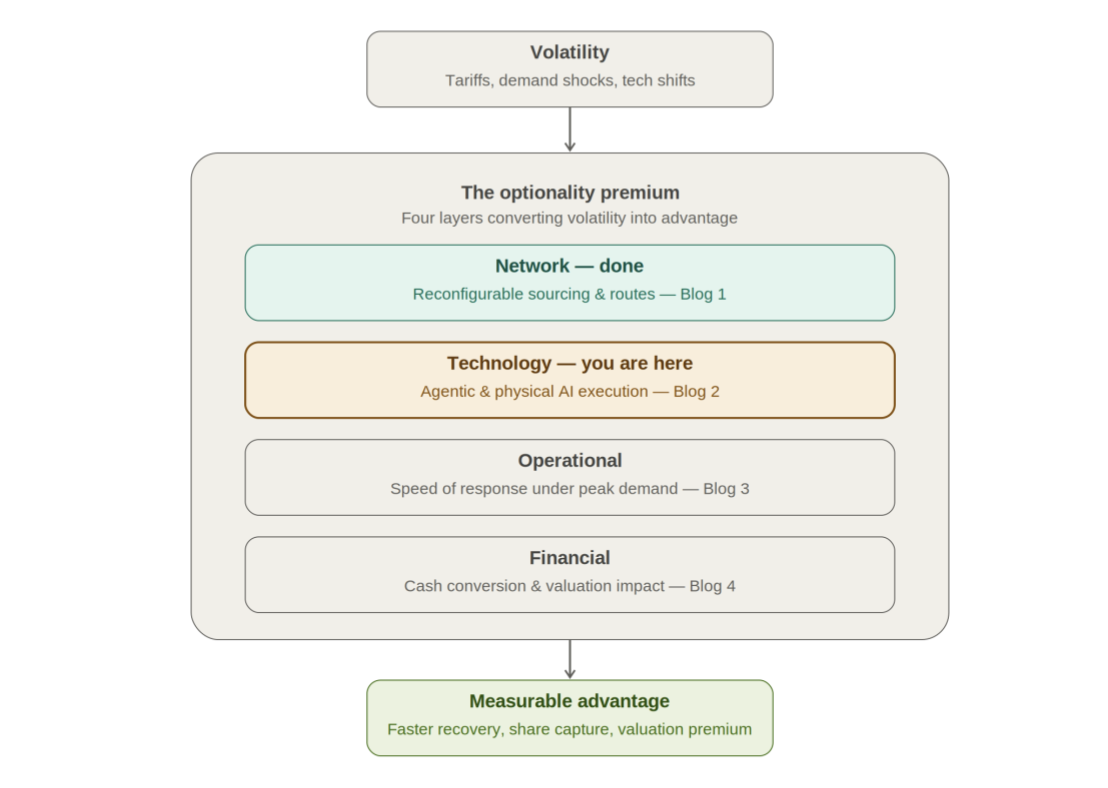
This is the second layer of the Optionality Premium™ I introduced in Blog 1. Network optionality — the reconfigurable sourcing and trade routing I wrote about there — is only real if the factory floor behind it can absorb the reconfiguration. A network that can nearshore production to Mexico on paper, but whose automation is hard-tooled to one product mix, doesn't have optionality. It has a plan that assumes nothing changes on the shop floor, which defeats the point.
Polyfunctional robotics, agentic scheduling systems, and digital twins that let you simulate a changeover before you execute it — these are what make network-level reconfiguration something you can do in weeks rather than a multi-year capital cycle. Nearshoring without this layer is a real estate decision. Nearshoring with it is a structural advantage, because the labor-cost gap that nearshoring alone doesn't fully close gets closed by throughput per worker instead.
Where the Governance Question Gets Real
The trust-and-governance piece of this shift isn't an afterthought — it's the part most organizations are underinvesting in relative to the hardware. A polyfunctional robot that can be redeployed across tasks also needs a decision boundary: which changeovers happen autonomously, which require a supervisor's sign-off, and what the fallback looks like when the system meets a task variant it hasn't seen. Reports from early deployments — mobile robots cutting inbound processing time by roughly 40% at one Asian distribution operation this year — are real, but they came from operations that built the governance model first, not as a retrofit.
The Practical Question
The technology to build a genuinely reconfigurable floor exists today. The constraint isn't the robot. It's whether your organization has decided which decisions it's willing to hand to one.
That decision, made deliberately or by default, is what separates the 13% from the 50% deployment.
Part 2 of a 4-part series on why optionality is becoming supply chain's most underpriced asset.
#SupplyChain #Automation #ArtificialIntelligence #Robotics #Productivity #DigitalTransformation #Investing #VentureCapital
