
Blog 2/3 FROM AI TOOLS TO AUTONOMOUS NETWORKS: Who Will Own the Execution Layer
THE MISPRICED LAYER: Why Supply Chain Will Define the Next Generation of Tech Winners
Who Will Own the Execution Layer
Artificial intelligence is now central to most investment narratives.
But there is a quiet mismatch in how it is being underwritten.
Most capital is still flowing toward AI that analyzes, summarizes, or recommends.
Far less attention is given to AI that executes.
That distinction matters.
Because in supply chains—and increasingly across technology businesses—
value is not created when a decision is identified.
It is created when that decision is carried through the system.
The Missed Layer
Over the last decade, companies have invested heavily in:
visibility platforms
analytics dashboards
forecasting tools
These systems improved awareness.
They did not fundamentally change execution.
As a result, many organizations can now see disruptions earlier—
but still respond to them slowly.
If Blog 1 established that supply chain is the constraint,
this is the next step: understanding who controls it.
The Shift to Execution
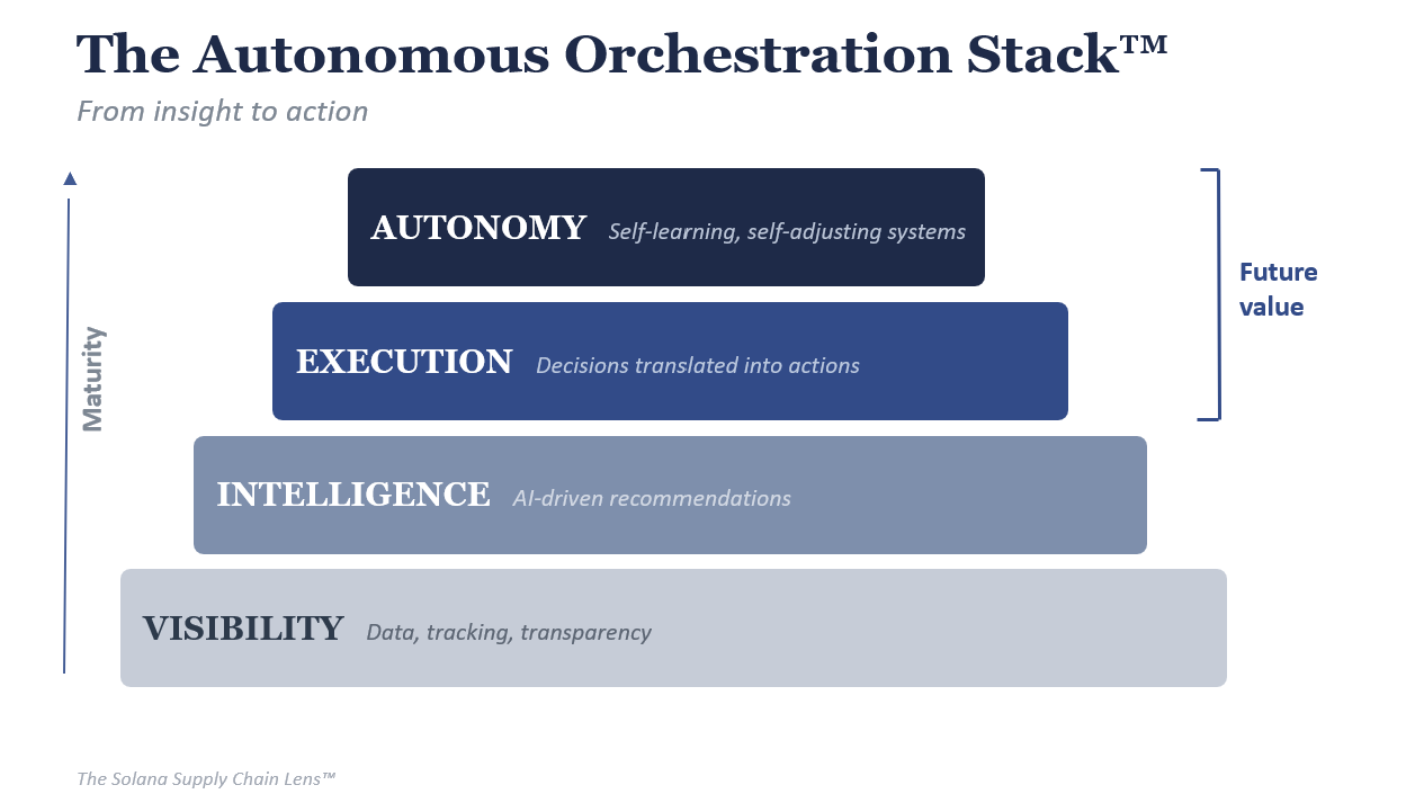
AI is evolving across four distinct layers:
Visibility — What is happening?
Intelligence — What should happen?
Execution — Make it happen
Autonomy — Systems adapt and act continuously
Most companies, and most investments, remain concentrated in the first two.
The next wave of value will come from owning the latter two.
Call this The Autonomous Orchestration Stack™.
Where This Is Playing Out
Consider NVIDIA.
The company operates within one of the most complex supply-demand environments:
multi-layered semiconductor manufacturing
constrained global capacity
highly volatile demand driven by AI adoption
Its advantage is not just product leadership.
It is the ability to coordinate across a distributed ecosystem with speed and precision.
This is orchestration—not just intelligence.
In a different model, Zara built a system that tightly connects:
real-time demand sensing
rapid production cycles
synchronized distribution
The result is shorter lead times and faster response to market signals.
Again, the advantage is not visibility alone.
It is closing the loop between signal and execution.
Emerging Control Points
New platforms are attempting to move up the stack.
Flexport is extending from coordination into deeper execution control across logistics flows
FourKites has built strong capabilities at the visibility layer and is expanding into orchestration
The strategic question is clear:
Who will own the layer where decisions become actions?
Implications for Investors
This shift changes how AI investments should be evaluated.
The key distinction is no longer:
How accurate is the model?
But:
How deeply is the system embedded in execution?
Can it trigger and manage real-world actions?
Does it improve decision speed across the network?
In other words:
Does the AI observe the system—or run it?
Closing
Insight is becoming abundant.
Execution remains scarce.
And scarcity is where value concentrates.
The next generation of category leaders won’t just understand their supply chains—
they will run them.
The Solana Supply Chain Lens™
Visibility informs. Execution performs.
Insights suggest. Systems deliver.
AI that stops at analysis is a tool. AI that drives execution is infrastructure.
The next generation of platforms won’t just support decisions.
They will make them happen.
This is Part 2 of 3 from a series on how supply chains are becoming the defining layer of modern technology companies.
