
Blog 3/3 RESILIENCE IS NOT DEFENSE: Why Supply Chain Maturity is Rewriting Tech Valuations
RESILIENCE IS NOT DEFENSE:
Why Supply Chain Maturity is Rewriting Tech Valuations
In most investment models, resilience is treated as protection.
A way to limit downside.
That framing is incomplete.
Because in today’s environment, resilience is not just about avoiding loss—
it is about capturing upside when conditions are unstable.
The Mispricing
Markets are highly efficient at pricing growth.
They are far less precise at pricing the ability to sustain and adapt that growth under stress.
This creates a persistent gap:
Companies are valued on expected performance in stable conditions—
but compete in environments that are anything but stable.
Geopolitical shifts, demand volatility, supply disruptions, capital constraints—
these are no longer edge cases.
They are the operating environment.
If Blog 2 established that control sits in the execution layer,
this is the outcome: who benefits when that control is exercised under stress.
From Efficiency to Adaptability
For decades, supply chains were optimized for efficiency:
lowest cost
lean inventory
global concentration
That model delivered margin expansion—until it didn’t.
Today, leading companies are re-optimizing for:
visibility across the network
adaptability in decision-making
speed of response
flexibility in sourcing and production
This is not a trade-off with growth.
It is increasingly a prerequisite for it.
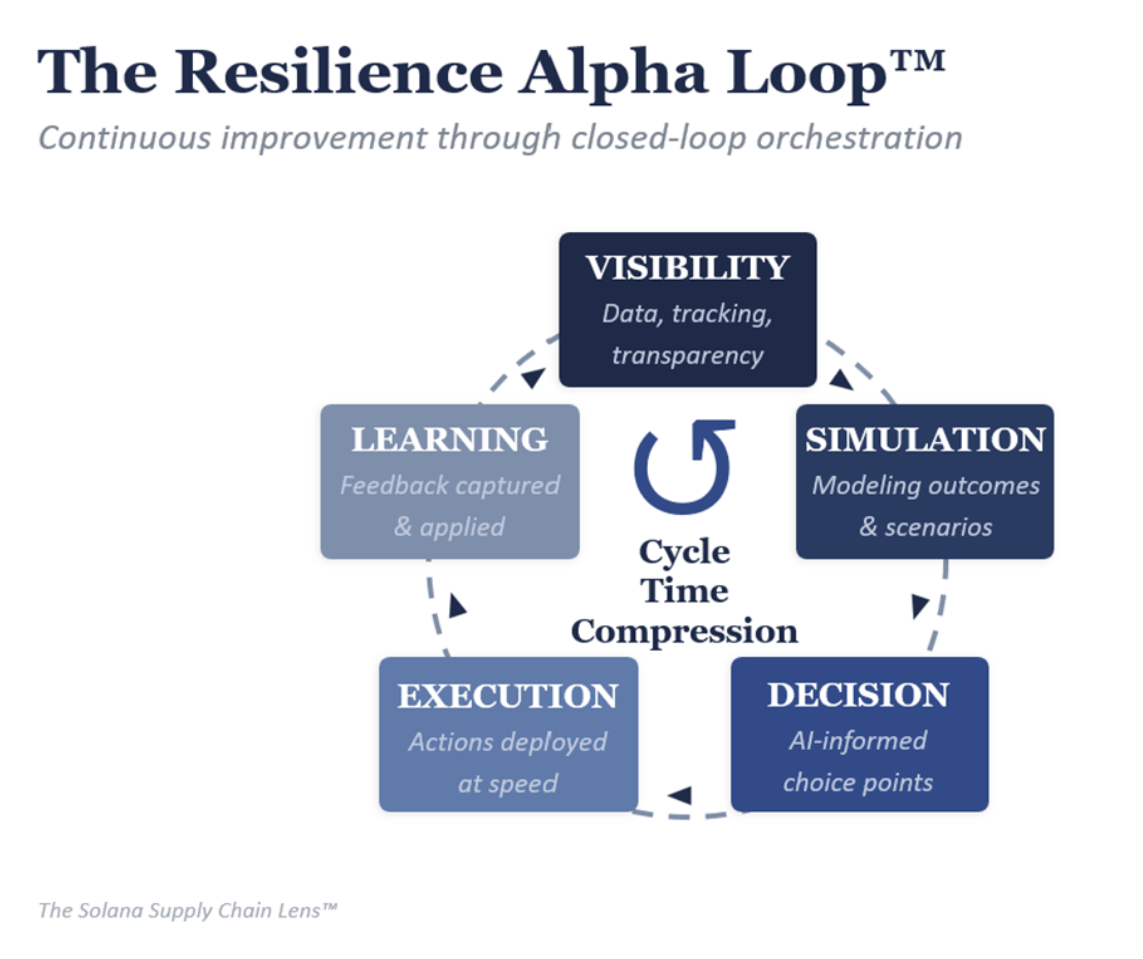
Introducing The Resilience Alpha Loop™
Resilience becomes valuable when it is operationalized.
The Resilience Alpha Loop™
Visibility → Simulation → Decision → Execution → Learning
Resilience is not a static capability.
It is the speed and frequency at which this loop can run.
Each cycle improves:
response time
service levels
cost efficiency
capital allocation
And more importantly, each cycle compounds.
Where This Shows Up in Practice
Consider Apple.
Apple operates one of the most complex global supply chains, yet consistently delivers:
synchronized product launches
high service levels
strong margin discipline
This is not just scale.
It is the result of multi-layered supplier strategies, operational visibility, and disciplined execution.
Resilience, in this case, supports predictability at scale—a key driver of valuation premium.
Similarly, Walmart has invested heavily in:
inventory visibility
logistics infrastructure
supply chain technology
During periods of disruption, this translated into:
stronger in-stock performance
faster response to demand shifts
market share gains
Again, resilience did not just reduce risk.
It enabled offensive positioning.
The Pattern Behind Outperformance
Across industries, a consistent pattern emerges:
Companies with higher supply chain maturity:
recover faster from disruption
adapt pricing and inventory more dynamically
maintain service levels under stress
capture share when competitors stall
This is not anecdotal.
It is structural.
Implications for Valuation
This shift has direct implications for how companies should be valued.
Resilience impacts:
Revenue quality → fewer disruptions, more consistency
Margin durability → better cost control under volatility
Capital efficiency → optimized inventory and working capital
Earnings volatility → faster recovery cycles
Yet most valuation frameworks do not explicitly account for these factors.
Which leads to a disconnect:
Operationally resilient companies are often undervalued relative to their true performance potential.
In effect, resilience reduces downside variance while increasing upside capture—
a combination most models fail to fully price.
A More Complete Investment Lens
If resilience is a growth driver, it should be assessed accordingly.
A few questions worth elevating:
How quickly can the company reconfigure its supply network?
What level of visibility exists beyond tier-one suppliers?
How fast can decisions translate into execution?
How many cycles of adaptation can the system run in a given period?
At the center of all of these is one metric:
Cycle time.
Because in volatile environments:
The company that learns and adapts faster captures the advantage.
Closing
Resilience is often framed as protection.
In practice, it is acceleration.
It determines not just how a company withstands disruption—
but how quickly it moves through it.
And over time, that speed compounds.
The next generation of leading technology companies will not be defined solely by what they build—
but by how effectively they sense, adapt, and execute under pressure.
That is not risk management.
That is alpha.
The Solana Supply Chain Lens™
Stability is assumed. Volatility is real.
Efficiency optimizes margins. Resilience compounds growth.
Speed of adaptation defines competitive advantage.
Resilience is not a buffer against uncertainty.
It is a system for outperforming within it.
This is Part 3 of 3 from a series on how supply chains are becoming the defining layer of modern technology companies.
