
From Trade Shock to Cash Signal: Where Optionality Actually Gets Paid
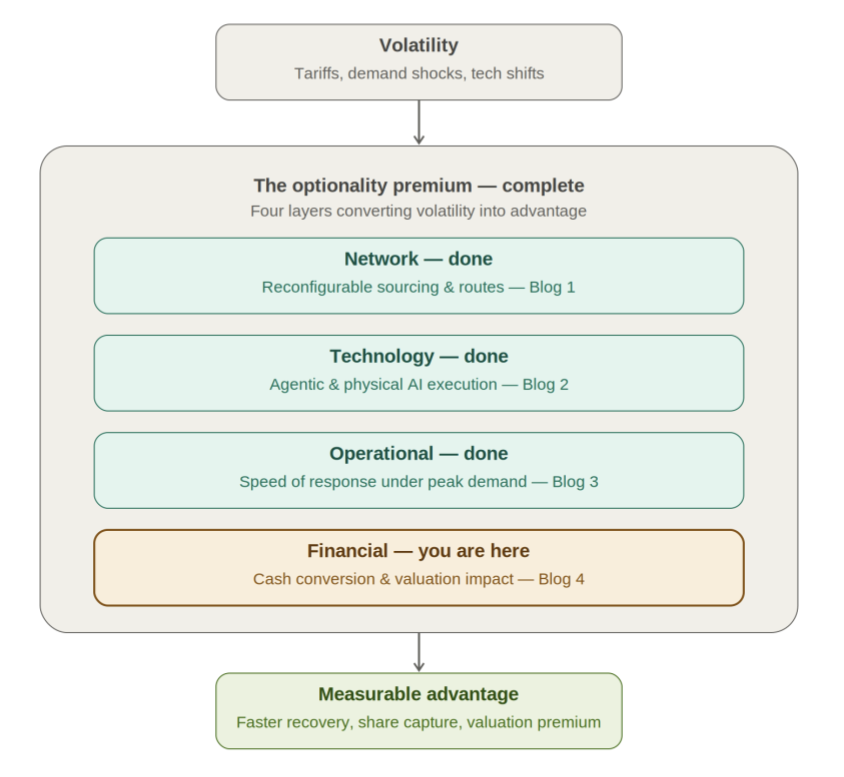
A trade shock, a robot, and a faster response to peak season are three different stories until they hit the same balance sheet.
Then they're one story: how much cash your optionality actually freed up.
This is the fourth and closing post in a series about why optionality is becoming supply chain's most underpriced asset. The first three made the operating case: a reconfigurable trade network (Blog 1), a factory floor that can absorb change without a redesign cycle (Blog 2), and an organization fast enough to act on both under real pressure (Blog 3). All three are true, and all three are, on their own, still stories about capability.
This post asks the question a CFO always asks after the operating story: where does it show up in cash?
I spent thirty years in rooms where that question ended arguments. A regional VP could make a compelling case for more safety stock, a faster changeover line, a redundant supplier. The finance partner across the table asked one thing: what does this do to working capital? That question hasn't gotten less important because the tools got smarter. If anything, it's the one that decides whether everything in this series is a genuine asset or an expensive insurance policy nobody can point to on a return.
The Refund That Proves the Thesis
I want to start with a concrete example, because this series has made a lot of structural arguments and they deserve one moment of literal proof. Culp Inc., a publicly traded textile manufacturer, paid tariffs under the emergency powers framework that the Supreme Court invalidated in February 2026. The company filed a claim for the roughly $7.0 million it had paid under those now-illegal tariffs — and received the full refund in its fiscal 2027 first quarter.
Read that again: a Supreme Court ruling on trade policy became a specific, seven-figure line item on a specific company's cash flow statement, months later. That is Blog 1's argument, made literal. Trade shocks aren't abstractions you manage with a compliance memo. They are cash events, and the companies tracking the exposure precisely enough to file the claim were the ones who actually captured the reversal when it came.
The Cost of Buffer, Made Visible
Now the other side of the ledger. UFP Industries — a Fortune 500 manufacturer based in Grand Rapids, Michigan, and North America's largest converter of softwood lumber, supplying the construction, retail, and industrial packaging markets — reported its cash conversion cycle lengthened to 68 days in the first quarter of 2026, up from 62 days a year earlier. The company attributed it directly to higher safety stock, built to normalize inventory against softer demand. That's resiliency, exactly as I defined it in Blog 3: a deliberate buffer, absorbing uncertainty. It's also six additional days of cash tied up in inventory sitting on shelves rather than compounding somewhere else.
I'm not arguing against safety stock — sometimes it's the right call. I'm arguing that resiliency has a precise, measurable cash cost, and most organizations build it without ever pricing that cost against the alternative: agility, the Blog 3 argument, that lets you respond fast enough to need less buffer in the first place. A dollar of inventory sitting still and a dollar of inventory that can move are not the same dollar. One is defensive. One is optionality. The balance sheet doesn't distinguish between them unless you build the systems that do.
What CEOs Are Already Paying For
Here's a number I think understates its own importance. In a recent global survey by Proxima — the London-founded procurement and supply chain consultancy, now part of Bain & Company, whose client base spans Fortune 500 and FTSE 100 organizations — U.S. CEOs said they'd accept an average 17% increase in third-party supplier costs to guarantee supply chain resilience, with 70% willing to accept an increase of 11% or more.
That's not a hypothetical premium. It's already being paid, quietly, inside procurement contracts, whether or not the company calls it that. Most of it is being paid as a pure cost — a margin give-up to a supplier or an insurer in exchange for a promise. The entire argument of this series is that the same dollar, redirected toward network, technology, and operational optionality instead of pure buffer, buys something that compounds instead of something that just sits there waiting to be needed.
The Solana Supply Chain Lens™, Applied to Cash
The three structural shifts I laid out in my Q2 series translate directly here. Scale is modular, not linear: working capital should be positioned where it's reconfigurable — inventory held in nodes that can redirect, not centralized where it can only be liquidated slowly. Orchestration is autonomous, not manual: Deloitte's 2026 working capital research makes the point precisely — the differentiator this year isn't a quarter-end cash sprint, it's embedding working capital discipline into daily operating decisions through forecasting and automation, which is Blog 2's argument wearing a finance hat. Resilience is compounding, not defensive: every cycle of the Resilience Alpha Loop™ that runs faster, per Blog 3, releases cash faster the next time, rather than permanently parking it in buffer.
Closing the Loop
Four layers, one asset. A network that can reconfigure around a tariff shock (Blog 1). Technology that lets the factory floor absorb the reconfiguration without a redesign cycle (Blog 2). An organization fast enough to act on both before the window closes (Blog 3). And a finance function that can see, measure, and defend the cash this actually frees up (this post) — instead of an unpriced insurance premium nobody can point to on a return.
That is the Optionality Premium™, end to end. Not four separate ideas. One asset, measured four different ways, depending on which part of the business you're standing in when you look at it.
Most organizations don't have someone in the room who has actually stood in all four of those places — operated the network, run the automation program, managed the peak season war room, and answered to the CFO on what it all cost. In my experience, that's usually where the real gap sits. Not inside any single layer, but in the judgment to know which one needs the next dollar first.
The Practical Question
Every company in this series's examples — the one that got the tariff refund, the one whose cash cycle lengthened — made a choice about optionality, whether or not they called it that.
The only real question left is whether you're pricing that choice on purpose, or finding out what it cost you after the fact.
Final post of a 4-part series on why optionality is becoming supply chain's most underpriced asset. Read the full series at luisjsolana.com/blog.
#SupplyChain #WorkingCapital #Investing #GlobalTrade #Resiliency #OperationalAlpha #VentureCapital #PrivateEquity
